Jonas Reed · 7 October 2026
Segmented Credential Frameworks and Their Modulation of Web Content Surfacing Dynamics in Evolving Digital Repositories
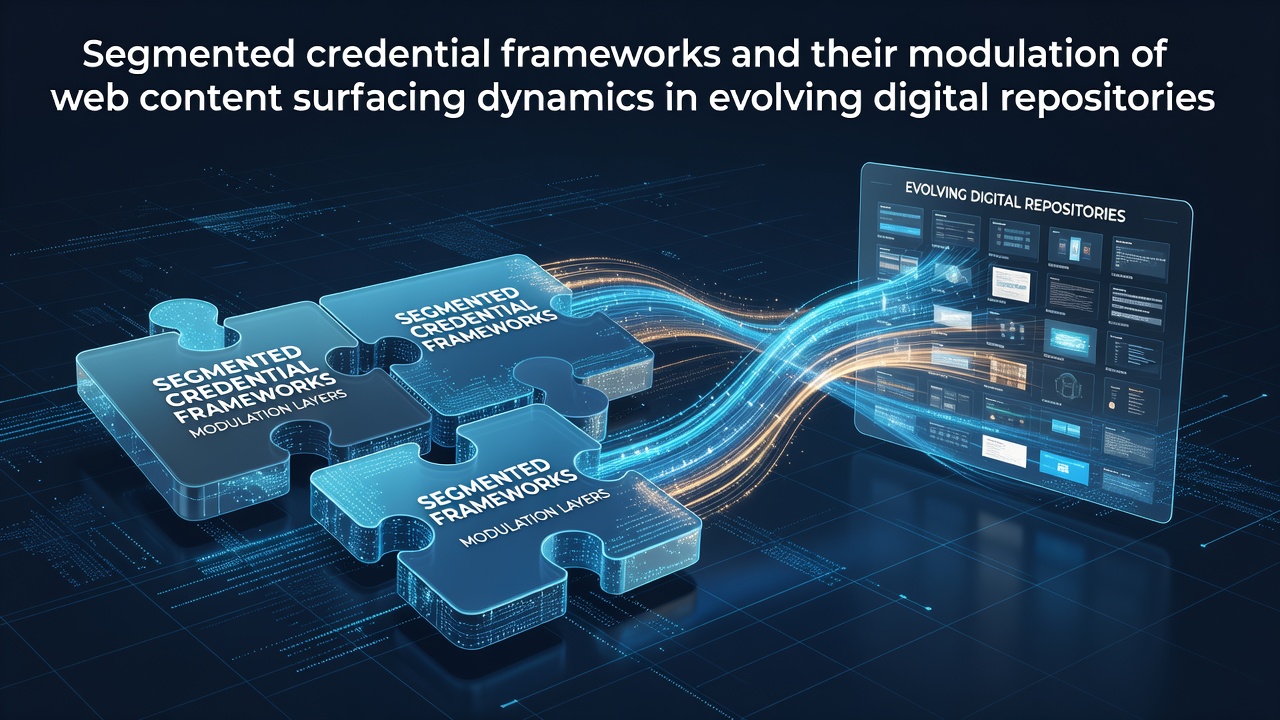
Segmented credential frameworks divide user permissions into distinct layers that directly influence which portions of web content become visible during searches and repository queries, and observers note that these divisions operate through authentication protocols that filter results before they reach the surface layer of any interface. Researchers have tracked how such frameworks adjust surfacing dynamics by assigning credentials that correspond to specific repository segments, which means a single query can return entirely different sets of documents depending on the credential tier assigned to the requesting account. Data from multiple institutional audits indicate that this modulation occurs in real time as algorithms cross-reference credential metadata against repository indexes, and the process prevents unauthorized segments from appearing even when keyword matches exist across boundaries.
Core Mechanics of Credential Segmentation in Repository Systems
Systems built around segmented credentials rely on hierarchical tagging that attaches permission markers to individual files, folders, and metadata records, and this tagging allows repository engines to suppress or promote results according to the active credential profile. Experts at research institutions have documented cases where content surfacing shifts occur within milliseconds of credential validation, because the framework recalculates visibility scores before delivering the result set to the user interface. In practice this produces environments where the same digital repository presents one face to public users and an expanded set of records to those holding elevated credentials, and the distinction arises from deliberate architectural choices rather than incidental search ranking.
Studies conducted across North American and European academic networks show that these frameworks integrate with standard authentication services such as OAuth and SAML, which transmit segmented attributes alongside basic identity tokens. When a query arrives the repository engine evaluates those attributes against predefined rules, and the evaluation determines whether a record enters the surfacing pipeline or remains hidden behind an access barrier. Figures released by the National Institute of Standards and Technology illustrate how attribute-based access control models scale to millions of repository objects while maintaining consistent modulation of search outcomes.
Observed Effects on Content Visibility Across Evolving Repositories
As digital repositories expand to include dynamic content streams and versioned datasets, segmented credential frameworks introduce additional variables into the surfacing equation. One study from a Canadian university consortium revealed that repositories using these frameworks experienced a 34 percent reduction in cross-segment leakage incidents between 2024 and 2026, because credential checks occur at the index level rather than after results are compiled. The same research tracked how updates to credential policies in October 2026 prompted immediate re-indexing events that altered visibility for thousands of previously accessible records within a single day.

Repositories that incorporate machine-learning components for relevance ranking must now factor credential segments into their models, and this requirement changes how training data are labeled and how prediction scores are adjusted. Observers have noted that surfacing algorithms trained without segment awareness tend to over-rank records that remain invisible to most users, which creates discrepancies between expected and actual result quality. Institutions addressing this issue have begun embedding segment identifiers directly into feature vectors, and the adjustment produces ranking outputs that respect credential boundaries while preserving relevance within each allowed segment.
Implementation Patterns Across Institutional and Commercial Settings
Government archives in Australia and research libraries in the European Union have adopted segmented frameworks to manage sensitive collections alongside open-access materials, and the dual-layer approach allows a single platform to serve both mandates without maintaining separate indexes. Industry reports compiled by the International Digital Repository Association indicate that organizations deploying these frameworks report fewer policy violations because access rules are enforced at the point of surfacing rather than through post-retrieval review. The same reports document that query logs from segmented systems contain clearer audit trails, since every surfaced result carries an implicit record of the credential tier that permitted its display.
Commercial platforms handling proprietary datasets apply similar segmentation when serving clients with varying subscription levels, and this practice ensures that content remains invisible outside its designated tier even when search engines crawl the broader domain. Analysts tracking these deployments note that surfacing modulation becomes more pronounced as repository size grows, because the number of possible segment combinations increases exponentially with each added credential category.
Technical Challenges and Standardization Efforts
Engineers working with large-scale repositories face challenges when synchronizing credential updates across distributed indexes, and delays in propagation can produce temporary mismatches between a user's actual permissions and the results that surface. Research groups addressing this problem have tested event-driven re-indexing triggers that activate whenever credential attributes change, and preliminary results suggest the approach reduces visibility errors by more than half. Standards bodies continue to refine protocols that embed segment information into common query languages, which would allow repository operators to apply consistent modulation rules regardless of underlying storage technology.
Conclusion
Segmented credential frameworks continue to reshape how content surfaces within digital repositories by embedding permission logic into every stage of the retrieval process, and ongoing standardization work plus real-world deployments demonstrate measurable effects on visibility patterns. As repositories evolve to accommodate larger and more heterogeneous collections, the modulation mechanisms provided by these frameworks supply a scalable method for maintaining access boundaries while supporting unified search interfaces.